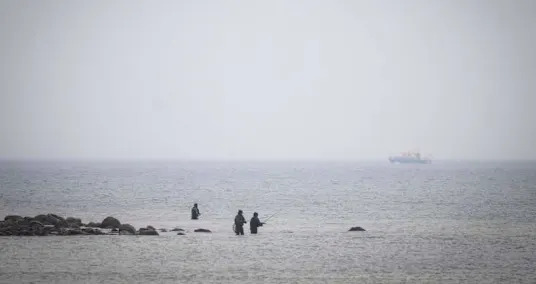
A humpback whale stranded for days off Germany's Baltic coast has gotten stuck on another sandbank, a Greenpeace spokeswoman said on Saturday.
The unlucky animal had garnered media attention for days, after it got stranded on a sandbank off Germany's Timmendorfer Strand resort, near the city of Lübeck, early on Monday.
Days of efforts to free the 12- to 15-metre whale proved unsuccessful until rescuers dug out a channel in the sand around the animal using a floating excavator on Thursday, allowing the whale to swim free the following night.
However, environmentalists and marine experts had feared that the animal could potentially get stuck again, as it was spotted heading back towards shallower water following its release.
Those fears became reality on Saturday, with the whale spotted stranded on a sandbank in the Bay of Wismar, some 40 kilometres to the east of Timmendorfer Strand, according to Greenpeace.
Large whales such as humpback whales are not native to the Baltic Sea. They may follow schools of fish in search of food and end up in the Baltic Sea.
According to experts, underwater noise could also play a role.

LATEST POSTS
- 1
 Material of Innovativeness: A Survey of \Releasing Your Imaginative Potential\ Online Workmanship Course
 - 2Manual for Wonderful Getaway destination
- 3Exclusive-Head of Pemex's production arm to step down in coming days, sources say
- 4I'm 18 and founded an AI startup. I have to wake up at 3 a.m. to work on it before school, but it's worth every sleepless night.
- 5Manual for Picking the Ideal Wine Matching



- German foreign minister backs abandoning EU's unanimity principle
- Tech Development Disclosed: A Survey of \Usefulness and Configuration in Concentration\ Tech Item
- Holiday destinations for Creature Sweethearts
- High Court weighs Assenheim appeal over release of Feldstein interview raw footage
- Israel Police decry online defamation campaign against female officer in Jerusalem
- The Best 15 Applications for Efficiency and Association
- Members of Kenya-led security mission in Haiti were involved in rapes, U.N. says
- Investigate Something else for Less: Financial plan Travel Objections
- Most loved Seared Chicken: Which Chain Rules?