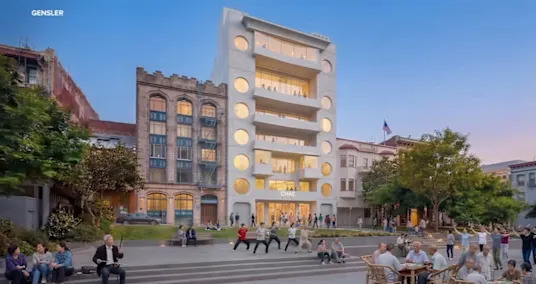
One of the most iconic towers in San Francisco's Chinatown is set to become a new cultural destination.
Community and city leaders unveiled plans Thursday to transform the historic Empress of China building into a cultural campus celebrating Chinese-American art, culture and history.
Once home to the famed Empress of China Banquet Hall, the building has been mostly vacant since it shuttered in 2015.
The nonprofit Chinatown Media and Arts Collaborative, a coalition of local nonprofits, finalized purchase of the property on Wednesday after a 15-year fight between the group and real estate investor John Yee, the building owner who was reluctant to sell.
San Francisco Supervisor Connie Chan said the prolonged vacancy took an emotional toll on the community.
MORE: SF Chinese Culture Center, oldest of its kind in the nation, celebrates new permanent home
"The view that you will see here is what your dreams can be beyond being and growing up in Chinatown," she said. "That was the dream that I had... and to see that how it left empty for so long, I think it broke a lot of our hearts."
CMAC plans to revitalize the 60-year-old structure into what leaders describe as a bustling ecosystem for Chinese-American celebration. The project includes a museum showcasing Chinese-American art, history and culture, along with other spaces aimed at drawing both locals and visitors.
"It's going to be a beacon for visitors and tourists to come to Chinatown to understand our story, a platform for us to tell our story," said Malcolm Yeung, CEO of the Chinatown Community Development Center. "We want to invite all of the supporters out there and helping us to determine how we use this building to tell our story in a way that is consistent with who we are as Chinatown."
Mayor Daniel Lurie connected the project to the city's broader recovery, both culturally and economically.
"I often say that as Chinatown goes, so goes San Francisco," Lurie said. "Our city does not succeed unless all neighborhoods see the benefits of a lasting recovery."
MORE: San Francisco's Chinatown pushes for preservation amid decline in business
Leaders say the project could also support the recovery of downtown San Francisco by drawing more visitors through Chinatown.
"Chinatown, because we are a living community where people actually come, we could direct people to downtown," said Mabel Teng, a board member of CMAC. "So I see us as serving as one of many engines that contribute to the city's recovery."
Teng, a former San Francisco supervisor, said the part of the sale agreement with Yee was to not disclose the cost of the sale. She said fundraising will be needed to sustain the project moving forward. Yee bought the building for $17.25 million in 2016.
"We all know fundraising is not easy. It is asking all our stakeholders and community to invest in their family's future," Teng said. "We have a future that we all share. We all share aspiration of what America promised to us."
She added that CMAC plans to keep the top and bottom floor restaurants, Empress by Boon and City View, in the tower.

If you're on the ABC7 News app, click here to watch live
LATEST POSTS
- 1
 Could it be said that you are As yet Utilizing Old Tires? at These 6 Tire Brands
 - 2Instructions to Discuss Successfully with Your Auto Collision Lawyer
- 3The 15 Most Powerful Forerunners in Business
- 4Find the Standards of Viable Refereeing: Settling Debates with Strategy
- 5Chinese mega embassy could bring security advantages, says No 10





- Vote in favor of your Favored kind of craftsmanship
- 7 Fun Plans to Make Film Evenings Seriously Invigorating (You'll Cherish #5!)
- Tatiana Schlossberg, a granddaughter of JFK, is dead at 35 after cancer diagnosis
- Modern surgery began with saws and iron hands – how amputation transformed the body in the Renaissance
- Who plays Moana in the live-action remake? What to know about Catherine Lagaʻaia.
- What happened to Eleven after the ambiguous 'Stranger Things' series finale? Millie Bobby Brown knows — but 'swore herself to secrecy'
- Book excerpt: "Eat Your Ice Cream" by Ezekiel J. Emanuel, M.D.
- What's inside Mexico's Popocatépetl? Scientists obtain first 3D images of the whole volcano
- Fundamental Home Machines: An Easy to understand Determination Guide


