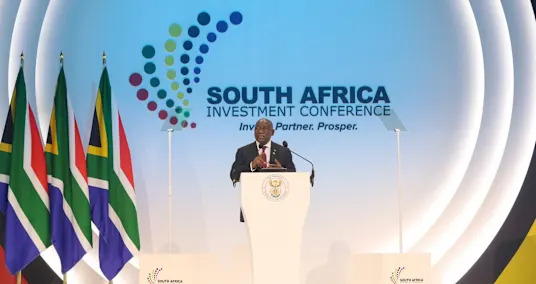
South African President Cyril Ramaphosa launched a nearly $200 billion investment drive aimed at accelerating economic recovery and industrialization in the face of growing worry over the impact of the Iran war on the continent’s biggest economy.
For more than a decade, South Africa’s economy has barely grown, leaving it with crumbling infrastructure and the need to create jobs in a country where one in three people are unemployed. Ramaphosa’s pitch to investors in Johannesburg this week was that South Africa has fixed the worst bottlenecks: He said the country is opening key sectors to private capital and is ready for large scale investments.
Ramaphosa said the effort will run through 2030 with delegates at the South African Investment Conference pledging $53 billion across 31 projects spanning energy, logistics, manufacturing, and digital infrastructure. They include Coca-Cola’s $1 billion expansion plan, and a $3.6 billion commitment from Sasol — the world’s biggest maker of fuel from coal — to upgrade operations.
LATEST POSTS
- 1
 Netflix's 'Lord of the Flies' show blends 'Adolescence' and 'Yellowjackets'
 - 2The Best 15 Applications for Efficiency and Association
- 3WHO suspends Gaza medical evacuations after contractor killed by Israeli troops
- 4Find the Marvels of the World with These Travels
- 5Home Remodel Administrations: Change Your Residing Space




- FACT FOCUS: Trump sows confusion on number of childhood vaccinations
- Aspect Biosystems receives funding for cellular medicine project
- Understanding Preschool Projects: Cultivating Abilities and Advancement
- Ukrainian Army Converts E38 BMW 7-Series Into Multiple Rocket Launch Platform
- Antimatter took to the road for the very first time. Here’s why it matters
- Russian strikes on Ukraine kill 5 people and wound 30 more
- Cyclone causes blackout, flight chaos in Brazil's Sao Paulo
- Wegmans recalls mixed nuts over salmonella contamination fears
- ‘The White Lotus’ sparked online interest in risky anxiety pills, study says