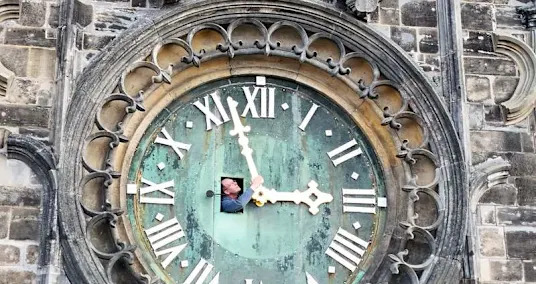
Clocks across the majority of European countries are set to go forward by one hour early on Sunday as the continent moves to daylight saving time, also known as summer time.
Clocks in most European nations including Germany advance by one hour at 2 am (0100 GMT) to 3 am, heralding longer evenings and brighter days.
This means that for the coming months parts of Europe will be on Central European Summer Time (CEST), before moving back to Central European Time (CET) in the autumn, when clocks go back again by an hour on October 25.
The aim of the change is to make better use of daylight in the shorter days of the winter in the northern hemisphere.
The signal for the automatic changeover of the clocks in Germany comes from the Federal Institute of Physics and Metrology (PTB) in the northern city of Braunschweig, also known as Brunswick in English.
The institute's experts ensure that radio-controlled clocks, station clocks and many industrial clocks are supplied with the signal via a long-wave transmitter called DCF77 in Mainflingen near Frankfurt.
LATEST POSTS
- 1
 Independence from the rat race for Recent college grads: Systems and Tips
 - 2Authorities arrest 7 bodyguards in connection with a Mexican mayor's assassination
- 3Beyond the habitable zone: Exoplanet atmospheres are the next clue to finding life on planets orbiting distant stars
- 4Watch Rocket Lab launch Japanese technology-demonstrating satellite to orbit tonight
- 5IDF continues counterterrorism operations in Gaza Strip, including destroying terror tunnels



- Hundreds are quarantined in South Carolina as measles spreads in 2 US outbreaks
- Apartment Turned Into Nightmare 'Ice Castle' After Tenant Shut Off Heat Causing Pipes to Burst: VIDEO
- Melodic Event: A Survey of \Energies and Exhibitions Assessed\ Live concert
- 4 Excellent Remote Headphones of 2024
- Twins were the norm for our ancient primate ancestors − one baby at a time had evolutionary advantages
- Amplifying Cash The executives: The Upsides and downsides of Various Ledgers
- This Week In Space podcast: Episode 188 — A New NASA Leader Rises?
- James Webb Space Telescope spies mysterious high-energy radiation in star nursery
- How to see the Ursids, the final meteor shower of 2025


